The way organizations train employees is changing. Businesses now need learning experiences that can keep pace with new technologies, changing processes, expanding teams, and growing amounts of organizational knowledge.
Traditional courses remain useful, but modern L&D teams increasingly need more than a library of static training materials. They need systems that connect knowledge, course creation, learner support, assessment, and continuous improvement.
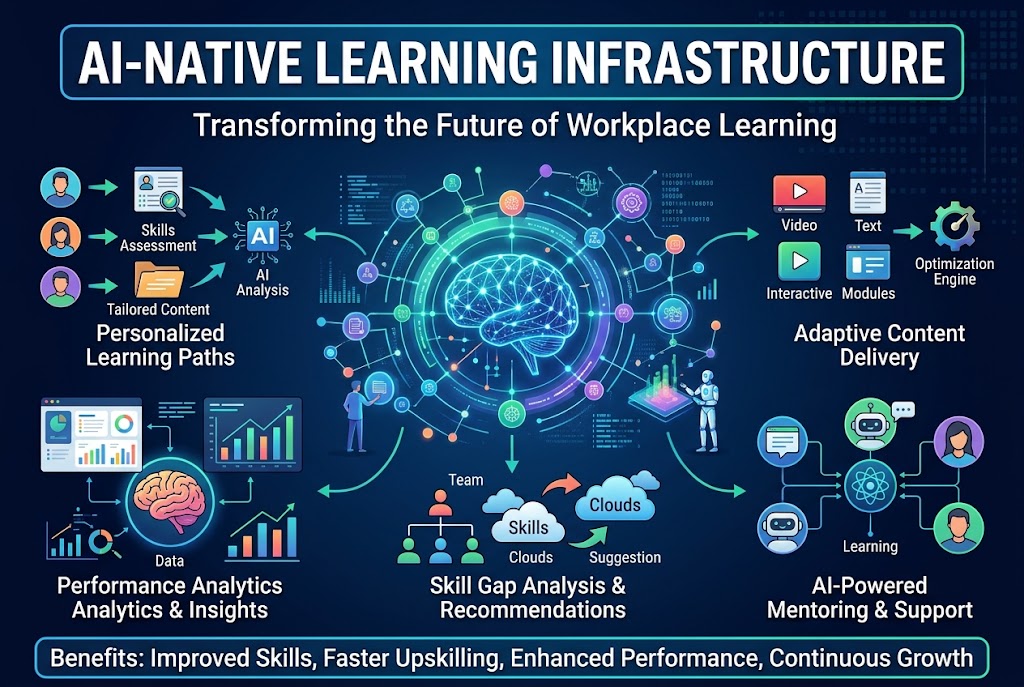
An AI-Native Learning Infrastructure provides a foundation for bringing these elements together and creating a more connected approach to workplace learning.
For many years, corporate learning followed a simple model: create a course, publish it, and ask employees to complete it.
This model works well for structured programs such as onboarding, compliance, and certification. However, employees often need knowledge outside formal training sessions.
They may need to understand a new process, solve a technical problem, learn about a product update, or make an important decision during their normal workday.
This creates a need for learning that is available when employees actually need it.
Modern workplace learning is becoming less focused on individual courses and more focused on continuous development.
Instead of treating training as a single event, organizations can create learning environments where employees have access to knowledge before, during, and after formal training.
A connected learning environment can include:
Together, these elements can create a more complete learning experience.
Mexty is an AI-native learning platform designed for educators, instructional designers, corporate trainers, and enterprise learning teams.
The platform brings together courses, interactive activities, evaluations, learning paths, knowledge bases, AI Agents, and analytics.
Instead of treating artificial intelligence as a separate feature, Mexty uses an AI-native approach across the learning workflow.
This can help teams accelerate learning creation while maintaining human involvement in reviewing and improving learning experiences.
Enterprise learning depends on accurate information.
Organizations already have valuable knowledge stored in policies, documents, product information, procedures, and internal resources.
The challenge is turning that information into learning experiences while keeping the content aligned with approved organizational knowledge.
A Source of Truth approach can provide a reliable foundation for AI-supported learning.
For example, when a company updates an internal process, that information can become part of the knowledge foundation used when creating or updating related learning experiences.
Simply providing employees with information does not always mean they will know how to apply it.
Interactive learning can help bridge that gap.
Organizations can turn existing knowledge into:
For example, a customer-service policy can become a scenario where employees must decide how to respond to a difficult customer situation.
This gives learners an opportunity to practice rather than simply read.
Developing learning experiences traditionally requires many manual steps.
Instructional designers may need to review source material, organize lessons, create activities, develop assessments, edit content, and prepare the final experience for publication.
AI can help accelerate appropriate parts of this process.
An AI-native workflow can assist with organizing information, creating learning structures, generating activities, and supporting repetitive development tasks.
However, human expertise remains essential.
Instructional designers and subject-matter experts can review AI-assisted content, improve explanations, adjust activities, and make sure learning objectives remain aligned with organizational requirements.
One of the biggest opportunities in modern learning is providing support after formal training ends.
AI Agents can help employees interact with organizational knowledge and continue learning during everyday work.
Depending on the learning environment, employees can use AI-supported interactions to:
This makes learning more accessible instead of limiting it to scheduled training sessions.
Different employees have different responsibilities.
A new employee may require basic onboarding, while an experienced specialist may need advanced technical training.
A connected learning infrastructure can support different learning paths while maintaining a shared foundation of organizational knowledge.
For example, the same product information could support:
New employees: introductory product knowledge.
Sales teams: customer-focused product scenarios.
Support teams: troubleshooting and service situations.
Managers: business context and decision-making activities.
This approach can make learning more relevant while maintaining consistency.
Learning becomes more useful when employees have opportunities to apply what they have learned.
Interactive assessments can help learners test their understanding through practical situations.
A learning experience could present a workplace scenario, ask the employee to choose an action, and then provide feedback explaining the result.
This creates a simple learning cycle:
Learn → Practice → Assess → Improve
It also gives L&D teams information about areas where learners may require additional support.
Publishing a learning experience is only the beginning.
L&D teams need to understand how employees interact with their learning programs.
Analytics can help organizations examine participation, assessment activity, and other learning signals.
These insights can help teams determine whether:
This supports a continuous improvement approach rather than treating every course as a finished product.
Organizations rarely remain static.
New products are launched, processes change, policies are updated, and employees take on new responsibilities.
Learning experiences therefore need to evolve as the organization evolves.
When learning is connected to organizational knowledge, teams can more easily identify which experiences may need to be reviewed when important information changes.
This can help reduce the gap between current business practices and older training materials.
Enterprise learning can involve sensitive information, including internal procedures, product documentation, compliance materials, and company knowledge.
As AI becomes part of learning workflows, organizations also need to consider how this information is managed.
A modern learning infrastructure should support appropriate governance, access controls, and responsible use of organizational knowledge.
This allows organizations to explore the benefits of AI while maintaining control over important business information.
The future of workplace learning is not simply about creating more courses.
It is about connecting the different elements of learning into a system that supports employees throughout their development.
Knowledge provides the foundation. Interactive learning helps employees practice. Assessments measure understanding. AI Agents provide ongoing support. Analytics help L&D teams improve the experience.
Together, these elements create a more connected learning ecosystem.
Modern organizations need learning systems that can adapt to changing knowledge, different employee roles, and continuous business development.
An AI-Native Learning Infrastructure can connect organizational knowledge, AI-supported content creation, interactive learning, assessments, AI Agents, learning paths, and analytics within one broader approach.
The objective is not simply to create training faster. It is to make learning more accessible, relevant, practical, and connected to everyday work.
As organizations continue adopting artificial intelligence, a connected learning infrastructure can provide a foundation for building scalable learning experiences that evolve alongside the modern workplace.

This post has been authored and published by one of our premium contributors, who are experts in their fields. They bring high-quality, well-researched content that adds significant value to our platform.