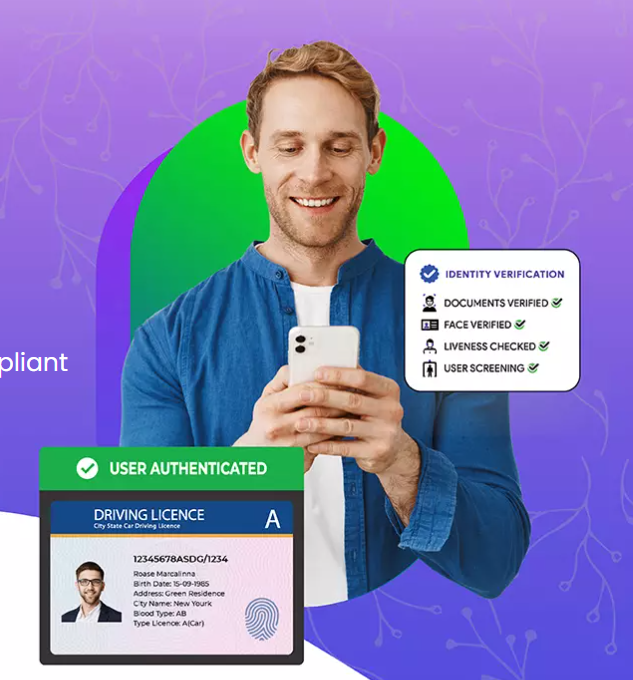
As digital services continue to expand, businesses need reliable ways to confirm that users are genuinely who they claim to be. Traditional passwords, PINs, and security questions are increasingly vulnerable to phishing, credential theft, and unauthorized access. Voice biometrics and facial verification provide modern identity authentication methods that use unique human characteristics to improve security while creating a smoother user experience.
Voice biometrics is a technology that analyzes distinctive characteristics in a person's voice to establish or verify identity. Rather than relying on a password or security code, the system evaluates voice characteristics and compares them with a previously registered voice profile.
Modern voice biometric solutions can examine various characteristics, including vocal patterns, pronunciation, rhythm, and other measurable voice features. When a person attempts to authenticate, their voice can be analyzed and compared with the stored biometric profile.
This technology can be particularly useful for applications such as customer authentication, financial services, contact centers, digital onboarding, and secure account access. By reducing dependence on knowledge-based credentials, voice biometrics can help organizations create an additional layer of identity protection.
Facial verification is a biometric authentication process that compares a person's face with a trusted reference image or previously registered facial profile. It is commonly used during identity verification, onboarding, account recovery, and secure access procedures.
A facial verification system analyzes facial characteristics and generates a mathematical representation of the face. The captured facial information can then be compared against the reference data to determine whether the identities correspond.
For digital businesses, facial verification can simplify identity checks while supporting automated verification workflows. It can be integrated into websites, mobile applications, and digital platforms to help verify users without requiring lengthy manual processes.
Using voice biometrics and facial verification together can provide a more comprehensive approach to digital identity security. Each technology relies on a different biometric characteristic, allowing organizations to introduce multiple verification signals into an authentication workflow.
For example, during a remote onboarding process, a user may be asked to capture a facial image and provide a short voice sample. The facial verification system can compare the person's face with an identity document or registered profile, while voice biometrics can provide an additional authentication factor.
This layered approach can be useful for organizations dealing with sensitive information, financial transactions, customer accounts, and other services where identity assurance is important.
Implementing biometric verification can provide several practical benefits:
Organizations should also consider factors such as consent, privacy, data protection, presentation-attack detection, accuracy, accessibility, and regulatory requirements when implementing biometric technologies.
As digital transactions become increasingly remote, businesses are looking for authentication methods that balance security, convenience, and usability. Voice biometrics and facial verification are becoming important components of this evolving identity technology landscape.
When implemented responsibly, these technologies can help organizations build stronger verification workflows while making authentication easier for legitimate users. Combining facial and voice-based biometric signals can also provide businesses with a flexible foundation for securing digital interactions across multiple channels.
For organizations investing in modern identity verification, voice biometrics and facial verification can play an important role in developing secure, efficient, and user-friendly authentication experiences.

This post has been authored and published by one of our premium contributors, who are experts in their fields. They bring high-quality, well-researched content that adds significant value to our platform.