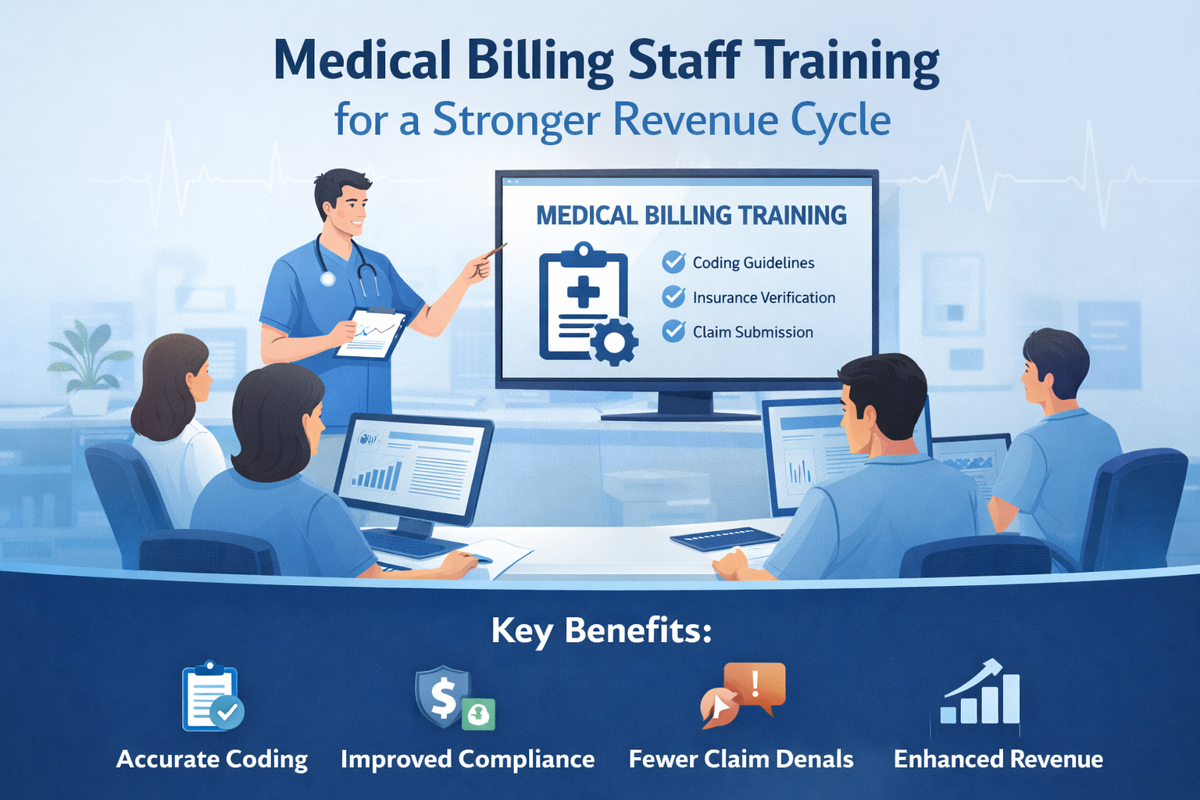
Effective billing begins with well-trained staff. Practices that invest in comprehensive training—from front-desk intake to coding, claims processing, and collections—see faster payments, fewer denials, and happier patients. This guide outlines how to educate your team at every step of the revenue cycle: defining clear roles (front desk, coders, AR), using hands-on scenarios and simulations, and measuring success with key performance indicators. It also covers creating up-to-date documentation/SOPs, teaching communication skills for patient billing discussions, cross-training staff to cover multiple functions, and mastering billing software. Finally, we discuss how partnering with a medical billing company or outsourcing can augment in-house efforts. By following these best practices, practices can turn billing staff into a “revenue cycle dream team”.
Medical billing is critical to a practice’s financial health. Errors in coding or data entry can delay reimbursements or trigger denials, directly impacting cash flow. A well-trained team “reduces denials, speeds up collections, shortens days in A/R, and protects compliance”. For example, industry data show denial rates average 5–10% in many practices, so ongoing education is “the cornerstone of financial viability”. Training helps staff see the big picture: as one AMA study notes, optimal revenue cycle management requires a collaborative process where “each player understands their role and how it fits in the broader cycle”. When everyone grasps the importance of clean claims and accurate data, the team works more efficiently and causes fewer downstream problems.
The revenue cycle spans every encounter from patient check-in through final payment. Core steps include:
Each phase is an opportunity for error or improvement. Role-based training should make clear how tasks are connected. For instance, front-desk mistakes in insurance data often cause 20–30% of claim rejections. Training should “contextualize” workflows so staff know why accuracy matters (matching each role’s work to revenue outcomes).
One training program does not fit all. Tailor instruction to each role’s duties. Key roles include:
Front-Desk Staff/Registrars: Focus on data integrity. Train them to enter patient demographics and insurance exactly, verify eligibility and benefits, collect co-pays at check-in, and obtain needed authorizations. For example, staff should practice using the EHR’s eligibility tool and learn common insurance rules (e.g. pre-authorization for certain procedures). Clear workflows (checklists for what to collect at each type of visit) help prevent intake errors.
Medical Coders/Billers: Emphasize coding accuracy and rules. Staff should master CPT, ICD-10, and HCPCS codes, and keep up-to-date with changes. Training modules can cover specialty-specific content (for example, teaching internal medicine coders how to apply chronic care management or preventive service codes). Include exercises on using modifiers correctly and understanding medical necessity. One source advises dedicated coding drills using real charts and latest CMS rules. Regular coding quizzes or audits help reinforce accuracy.
Billing and A/R Specialists: Train on claim workflows and follow-up. Billers should know how to enter charges, use claim-scrubbing tools, and submit clean claims. A/R staff must be skilled at monitoring aging reports, managing denials, and running appeals. For example, an exercise might involve investigating unpaid claims: trainees identify missing authorizations or documentation gaps and practice filing appeals. Providing role-specific SOPs and checklists (e.g. step-by-step claim review guides) ensures consistency.
No role should work in isolation. Periodically run cross-role workshops so, for instance, coders learn about front-desk check-in steps and vice versa. This fosters understanding of how one person’s error can impact another’s work (e.g. how incomplete registration data complicates coding).
Billing rules change constantly (new CPT codes, updated ICD-10, evolving payer policies, CMS regulations, etc.). A single orientation is not enough. Schedule recurring training: monthly updates or quarterly workshops to cover the latest changes. For example, one expert recommends modular updates like “ICD-10 Quarterly Updates” to keep staff current on coding revisions. Another source notes that practices achieving denial reductions all shared one habit: comprehensive, ongoing staff training.
Use a combination of methods: brief huddles or emails to highlight urgent news, and formal refresher sessions for complex topics. Monitor payer bulletins (e.g. from CMS or major insurers) and disseminate summaries to the team. Encourage staff to pursue continuing education and certifications: support AAPC CPC/CPB or AHIMA CCS/CRCR preparation, as these enhance expertise and credibility. In short, make learning a continuous process, not a one-time event.
Theory is important, but staff learn fastest by doing. Incorporate practical exercises that mirror real billing scenarios. For example:
Claim Walkthrough Workshops: Take de-identified real claims from your practice and walk through them start-to-finish. Trainees review the clinical note, identify diagnoses/procedures, check patient eligibility, and prepare the claim for submission. Begin with simple cases, then introduce complexities like multiple procedures, modifier usage, or coordination-of-benefits. This builds confidence in handling actual work.
Denial Drills: Present a past denied claim along with its Explanation of Benefits (EOB). Have staff diagnose the error (wrong code, missing authorization, etc.) and draft a corrected claim or appeal letter. Using real payer communications teaches them to interpret insurer language and improves problem-solving.
Software Simulations: Use a training (non-production) environment in your practice management/EHR system. Let staff post test payments, submit dummy claims, and work mock denials without risk. This hands-on practice is invaluable – actually clicking through the system trains better than lectures alone.
Role-Play Patient Intake: Have staff role-play common scenarios. One person acts as patient, another as receptionist verifying insurance and collecting co-pays. Practice scripts for discussing cost estimates or payment plans. This sharpens communication skills and highlights how accurate intake improves billing downstream.
Error Spot Challenges: Create quizzes or games around frequent mistakes. For example, give short case vignettes and ask trainees to pick the correct place-of-service or procedure code. Use examples of previous rejections and have teams brainstorm fixes. Such “billing Olympics” keep learning engaging.
Payer-Specific Scenarios: Present the same clinical case under two different insurers. Ask how the claim handling changes (authorization requirements, frequency edits, etc.). This teaches the principle that “it depends on the payer” and ensures staff pay attention to insurer details.
Peer Group Reviews: Divide the team into small groups to collaboratively work through a complex claim or denial. Discussions often uncover issues one person alone might miss. Encourage them to critique each other in a supportive way, and share best practices.
Aim for at least six such exercises, mixing individual and group work. Provide immediate feedback: explain what was done well and correct mistakes on the spot. Over time, this hands-on experience turns theory into skill and dramatically reduces on-the-job errors.
Training is most effective when backed by clear, written processes. Develop Standard Operating Procedures (SOPs) or manuals for each billing task. For example, create a “Patient Check-In SOP” that lists all forms to complete, or a “Denial Management SOP” outlining steps to review and refile claims. Include screenshots of your software screens, checklists of required data fields, and examples of correct entries. Keep these documents organized by function and update them whenever rules change.
Complement manuals with quick-reference aids: laminated cheat-sheets or job aids for high-frequency tasks. These might include a one-page summary of common ICD-10 codes, modifier usage guides, or a flowchart of the claims submission process. Also maintain an easily accessible knowledge base (digital or physical) that staff can consult in real time—for instance, a shared folder or intranet page with payer contacts, denial code explanations, and FAQ’s. Well-documented procedures ensure consistency, ease onboarding, and serve as a safety net when staff handle unfamiliar situations.
To gauge training effectiveness, track key billing KPIs. Monitor metrics such as:
Tracking these numbers helps pinpoint training gaps and measure progress. For instance, a rising denial rate might trigger a refresher in coding rules, while long A/R days suggest follow-up procedures need improvement. Review KPIs regularly in staff meetings, and tie them to training goals (“We need to cut our denial rate from 8% to 5% by retraining on modifiers”). Celebrating KPI improvements (like raising clean-claim rate) motivates the team. In short, use data to drive continuous learning and make training tangible.
Billing staff often interact with patients about their financial responsibility. Training should include customer service skills for these situations. Teach staff to explain insurance benefits and patient balances in clear, empathetic language. Role-play scenarios such as discussing a large co-pay or explaining a complicated bill. Emphasize listening and finding solutions (e.g. payment plans), rather than just reciting policy. Staff should practice setting expectations: for example, phrasing statements like “Your insurance covers 80% of this service, so you owe 20%” in a friendly manner.
Well-trained communication can improve patient satisfaction. When estimates and statements are clear and errors are rare, patients trust the practice more. This also reduces billing calls back to clinical staff. A recent article notes that beyond revenue, patient experience benefits — “fewer surprise bills and angry calls” — result when billing operations run smoothly. Include in training tips on answering questions about statements and directing patients to financial counselors if needed. Good communication is a key “soft skill” that complements technical billing expertise.
Create a flexible team by cross-training staff on each other’s tasks. Develop a skills matrix showing who can do what (e.g. who is trained on Medicare billing, who can handle AR follow-ups). Identify any single-person dependencies and remedy them. For example, if only one employee knows how to process Medicaid claims, arrange for a colleague to learn it. Consider job rotation: have staff spend time in adjacent roles (a coder might help with patient collections one week).
Cross-training builds depth and prevents workflow bottlenecks. It ensures that when someone is on leave or leaves the practice, others can step in without chaos. Moreover, it helps everyone appreciate each role: a front-desk worker who has done coding can better understand why accurate data entry matters. A resilient team that shares knowledge will keep billing operations steady under pressure.
Billing software and EHR systems are powerful tools—but only if staff know how to use them. Ensure training covers all key features of your technology:
As one expert noted, technology brings gains only if “staff are trained to use RCM tools effectively”. Leverage vendor resources: many systems have training modules, webinars or sandbox environments. When you roll out a new software version, provide quick refresher courses. Common features to master include claim status checks, batch claim submissions, and payment posting utilities. The goal is for staff to use tech to speed up the process and catch errors early, not create new confusion.
Many practices find that working with a medical billing company brings advantages. A good billing partner offers specialized expertise, advanced technology, and often hands-on training support for your team. They can help update your workflows, share best practices, and even participate in staff training sessions. For example, some billing companies provide regular webinars on compliance changes or join huddles to review denial trends.
When should you consider outsourcing? Common signs are frequent errors or denials, an overwhelmed staff, or stagnant collections. If internal billing becomes a drain on morale or resources, a partner can free up your team to focus on patient care. As one consultant notes, outsourcing can give you “more time to focus on patient care” and access to expert resources and technology that might otherwise be cost-prohibitive. However, choose your partner carefully: look for experience in your specialty, positive references, and compatibility with your software (they should be able to integrate with your existing systems).
Even with a billing company, your staff benefit from training. In-house team members still interact with patients and collect data, so they should understand core processes. Think of a billing partner as an extension of your education plan. Together, you can develop joint training where your staff learns the partner’s workflows and vice versa, ensuring a smooth revenue cycle. Ultimately, the goal is the same: reduce denials and delays. A well-trained team, whether internal or in partnership with experts, makes the practice more profitable and sustainable.
Training is not a one-time task but an ongoing investment that underpins efficient billing. By covering the full revenue cycle, delivering role-based instruction, and reinforcing learning with real-case exercises, practices can dramatically improve their financial performance. Structured SOPs, KPI tracking, and cross-training build a robust process; strong communication skills keep patients satisfied. Advanced tools and potential partners (medical billing companies) further amplify these gains. In short, well-trained billing staff — equipped with clear processes and technology — become the linchpin of a healthy revenue cycle, yielding faster payments and a stronger practice.

This post has been authored and published by one of our premium contributors, who are experts in their fields. They bring high-quality, well-researched content that adds significant value to our platform.