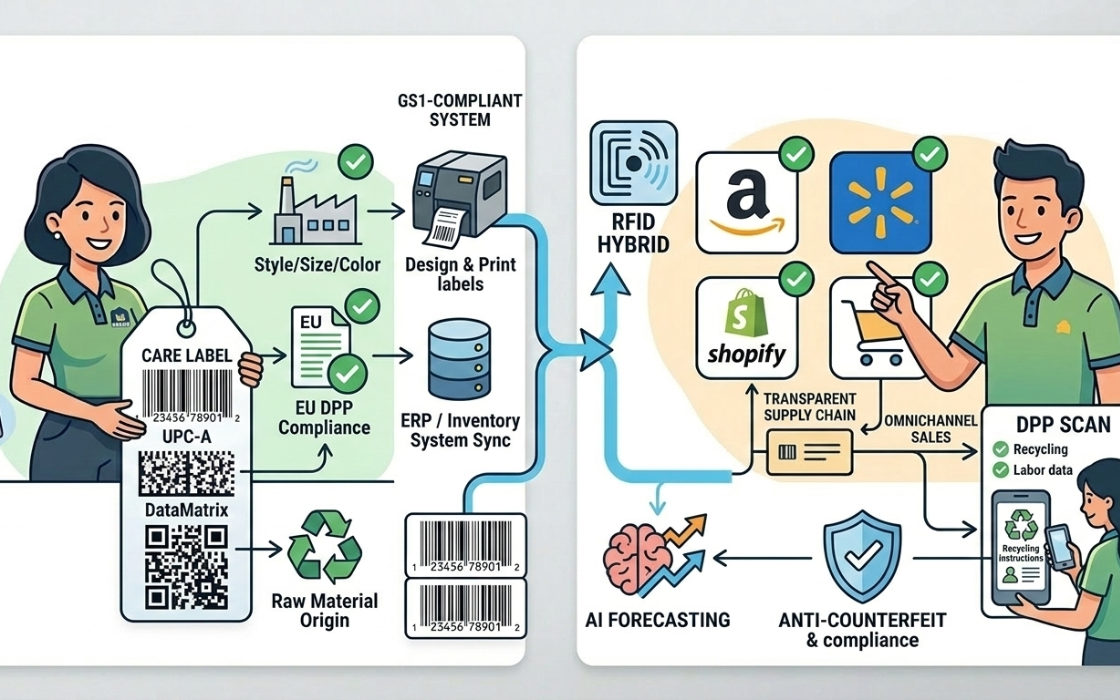
In the fast-paced fashion world of 2026, a single garment barcode is no longer just a black-and-white sticker; it's the backbone of smart inventory, transparent supply chains, and regulatory compliance. Whether you’re a small apparel startup or a global brand, implementing the right garment barcode system can cut stock errors by up to 99%, speed up checkout, and help you meet EU Digital Product Passport rules coming in 2027.
If you’re searching for “garment barcode”, “clothing barcode labels”, or “apparel barcode for inventory”, this ultimate guide covers everything you need.
A garment barcode is a unique machine-readable code printed on clothing tags, care labels, or hang tags. It encodes critical product data such as:
When scanned at any point in the supply chain (factory → warehouse → retail store → online order), the barcode instantly updates your inventory management system.
Unlike generic barcodes, GS1-compliant garment barcodes (UPC-A or EAN-13) are globally accepted by Amazon, Walmart, Flipkart, and every major retailer. They ensure your apparel products never get rejected at checkout.
Here’s a quick comparison table:
| Barcode Type | Digits | Best For | Advantages | Limitations |
| UPC-A | 12 | US & Canada retail | Widely accepted, compact | Less data capacity |
| EAN-13 | 13 | Europe, Asia & global export | Extra digit for country prefix | Slightly wider than UPC |
| Code 128 | Variable | Internal warehouse tracking | High data capacity | Not for retail POS |
| QR Code Hybrid | — | Consumer-facing + DPP compliance | Stores website links + sustainability data | Needs smartphone to scan |
| GS1 DataMatrix | — | High-density small tags | Tiny size, perfect for accessories | Requires special printers |
Pro Tip: Most apparel brands use EAN-13 + QR combo in 2026 EAN-13 for POS scanning and QR for Digital Product Passport.
Real-Time Inventory Accuracy
Faster Supply Chain & Logistics
Anti-Counterfeit & Theft Protection
Seamless Omnichannel Retail
Sustainability & Compliance (2026 Must-Have)
Cost Savings
Brands ignoring these trends are already losing market share.
A simple garment barcode is the cheapest and most effective technology still ruling the apparel industry. It saves money, reduces errors, builds customer trust, and prepares you for upcoming regulations.
Ready to launch or expand your clothing line?
Get authentic GS1-compliant garment barcodes (EAN-13 & UPC-A) instantly delivered with full certificate and images. Lifetime ownership, 100% retailer accepted.
Author Bio:
Written by [Talha Shoukat] Fashion Supply Chain Expert at GS1UPC.net. We provide 100% authentic GS1 barcodes for garments, apparel, and fashion accessories. Instant delivery, lifetime validity, and 24/7 support. Start selling on Amazon, Walmart & global retailers today.

This post has been authored and published by one of our premium contributors, who are experts in their fields. They bring high-quality, well-researched content that adds significant value to our platform.